The short answer
In Murfreesboro in 2026, removing a tree costs between about $250 and $7,000. A small ornamental or a Bradford pear in the open is $250 to $700. A medium hackberry, maple or cedar, 25 to 50 feet, with room to drop it is $600 to $1,500. A large hackberry, sugar maple, silver maple or oak, 50 to 80 feet, near the house, deck or service drop is $1,500 to $4,000 rigged down in sections. A dead ash of any real size runs $900 to $3,800 because it can't be climbed. Trees that need a crane — over the roof, on a tight lot, or too brittle to climb — run $2,500 to $7,000. Stump grinding adds $125 to $650.
Prices by size
| Tree | 2026 price | What's typical |
|---|---|---|
| Small tree, under 25 ft, open access | $250 – $700 | Bradford pear, dogwood, redbud, crape myrtle |
| Medium tree, 25–50 ft, open lot | $600 – $1,500 | Young hackberry, cedar, red maple — dropped whole |
| Large tree, 50–80 ft, near structures | $1,500 – $4,000 | Hackberry, sugar or silver maple, oak, poplar — rigged in sections |
| Dead ash (EAB), 30–70 ft | $900 – $3,800 | Bucket truck or crane; never climbed |
| Crane removal | $2,500 – $7,000 | Over the house or garage, tight lots, brittle trees |
| Emergency / storm | $600 – $4,500 | Nights, weekends, trees on structures |
| Stump grinding | $125 – $650 | $3 – $5 per inch of diameter |
What moves the price
What's under the tree
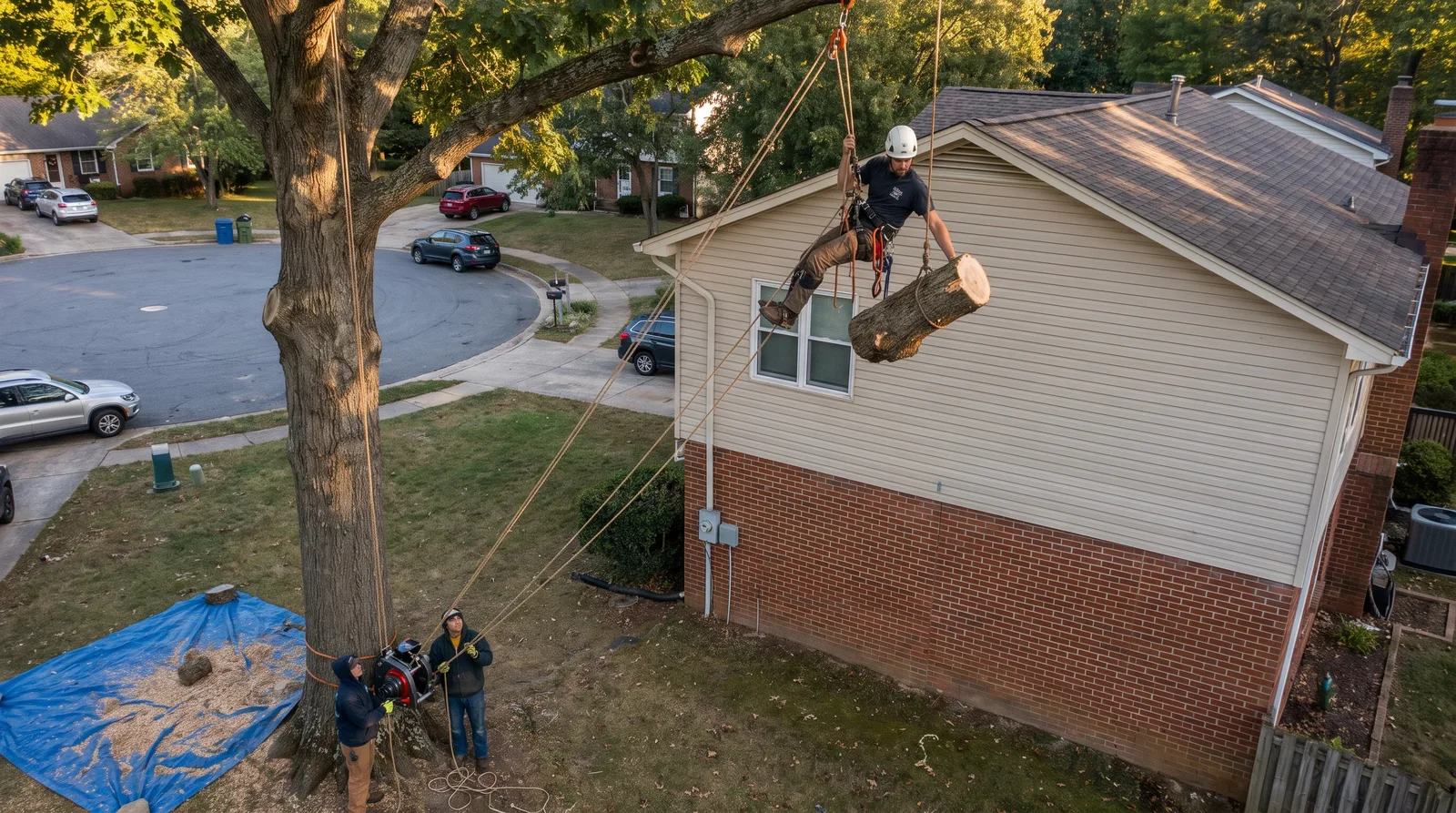
This matters more than height. A 60-foot hackberry on an open lot gets dropped in an hour. The same tree over a brick ranch, a deck and the neighbor's fence gets climbed and rigged down in fifty pieces, each one lowered on a rope. That's a full day for a crew, and it's why "near the house" doubles the price.
Whether it's dead
A dead ash, hackberry or silver maple can't safely hold a climber, so it comes down from a bucket truck or with a crane — and a badly deteriorated one has to be picked in small, careful pieces. The year a tree dies is the cheapest year to remove it.
Access
Can a bucket truck reach the tree? Is there a gate wide enough for a compact loader? Is the tree in a river bottom or on a slope? Every piece that has to be carried out by hand instead of driven adds time.
Species
Hackberry is fast to cut but heavy and brittle; oak and hickory are dense and slow; silver maple is soft but hollow and unpredictable; cedar is light and full of dead interior limbs that have to be cleared first. The arborist prices what the species actually takes.
The stump
Grinding is priced separately by the inch, and in Murfreesboro it often stops shallower than usual because the limestone is close to the surface. See the stump grinding page.
What a real quote includes
A written, itemized price should list: the tree or trees by species and size, the method (drop, rig, crane), what happens to the wood and debris, whether the stump is included, any city or HOA paperwork, the certificate of insurance, and how long the price is good for. If a quote is a number on the back of a card with no scope, you don't know what you're buying — and after a storm, that's how the out-of-town crews get you.
Common questions
Is it cheaper to remove a tree in winter?
Often a little — crews are less booked from December through February, the ground is firm, and there are no leaves to chip. It's also the right season to prune oaks. Storm work is the exception; after an ice event every crew in the county is busy.
Does insurance pay for tree removal?
Only when the tree hit a covered structure. A tree that fell in the yard is on you; a tree on the roof is usually covered, with a debris cap. See our insurance guide.
Why did I get three quotes that were $2,000 apart?
Usually because one of them is uninsured, one is guessing, and one has actually looked at what's under the tree. Ask each one for a certificate of insurance and an itemized scope and the spread usually explains itself.
Do you charge for the estimate?
No. The on-site look and the written price are free. An arborist's written risk assessment or a letter for the city or an insurer is a separate, small fee that's credited toward any work.
Can I save money by keeping the wood?
A little — leaving the trunk bucked into rounds saves the hauling. Oak, hickory and maple are worth keeping for firewood; hackberry burns fine but rots quickly.
Related: Tree removal · Crane tree removal · Stump grinding · Do you need a permit?